Showing posts with label Latin America. Show all posts

Friday, 10 October 2014

The Best TEFL Jobs in Peru

Here's the information for Peru for The Best TEFL Jobs in the World. The LA Job List has more schools in Peru that you might want to work for in Peru. You might also want to look at The Best TEFL Jobs With Worldwide Employers.  

If you know of any other good ones, please let me know by emailing me at naturegirl321@yahoo.com
  • Maximo Nivel (MN): They have institutes in Costa Rica and Guatemala as well. Their trainer positions pay between $1000 and $1800 a month. 
  • Universidad de Piura (UDEP): They give you a special OIM visa which is a type of diplomatic-volunteer visa that allows you to stay in Peru for a year. It's not a resident visa. Pay is about $700 a month and has been that way for the past ten years. They may help with housing for the first month and flights. It's a really good place to work. Here's the language center and info on how to apply.

Disclaimer:

Tuesday, 30 September 2014

The Best TEFL Jobs in Mexico

Here's the information for Mexico for The Best TEFL Jobs in the World. The LA Job List has more schools that you can work for in Mexico. You might also want to look at The Best TEFL Jobs With Worldwide Employers.  

I only know of one, so if you know of any other good ones, please let me know by emailing me at naturegirl321@yahoo.com
  1. Tecnologico de Monterrey (ITESM): Good pay, pay on time, do the paperwork for your visa (although you have to pay for it), and enroll you in health insurance 

Disclaimer:

Sunday, 28 September 2014

The Best TEFL Jobs in Guatemala

Here's the information for Guatemala for The Best TEFL Jobs in the World. The LA Job List has more schools that you might want to work for in Guatemala. You might also want to look at The Best TEFL Jobs With Worldwide Employers.  

I only know of one, so if you know of any other good ones, please let me know by emailing me at naturegirl321@yahoo.com
  1. Maximo Nivel: They have institutes in Costa Rica and Peru as well. Their trainer positions pay between $1000 and $1800 a month.

Disclaimer:

Saturday, 20 September 2014

The Best TEFL Jobs in Ecuador

Here's the information for Ecuador for The Best TEFL Jobs in the World. The LA Job List has more schools that you might want to work for in Ecuador. You might also want to look at The Best TEFL Jobs With Worldwide Employers.  

If you know of any other good ones, please let me know by emailing me at naturegirl321@yahoo.com
  1. British School of Language: Formerly known as Southern Cross. They help with visas and pay well.
  2. EIL (Experiment in International Living): They help with visas and pay well. 
  3. REACH Language Program through Kansas State: You'll need an MA plus 3 years teaching experience. There's orientation in Kansas. You have to be willing to commit for a minimum of 6 months and a max of 12. $38,000 a year working 8-5pm, may involve evenings and weekends. They usually advertise on TESOL.org. Here's an old job advert of theirs.

Disclaimer:

Friday, 12 September 2014

The Best TEFL Jobs in Costa Rica

Here's the information for Costa Rica for The Best TEFL Jobs in the World. The LA Job List has more schools that you might want to work for in Costa Rica. You might also want to look at The Best TEFL Jobs With Worldwide Employers.  

I only know of one, so if you know of any other good ones, please let me know by emailing me at naturegirl321@yahoo.com
  1. Maximo Nivel: They have institutes in Guatemala and Peru as well. Their trainer positions pay between $1000 and $1800 a month.

Disclaimer:

Wednesday, 10 September 2014

The Best TEFL Jobs in Colombia

Here's the information for Colombia for The Best TEFL Jobs in the World. The LA Job List has more schools that you might want to work for in Colombia. You might also want to look at The Best TEFL Jobs With Worldwide Employers.  

If you know of any other good ones, please let me know by emailing me at naturegirl321@yahoo.com
  1. British Council
  2. International House Bogota They pay around $2 million pesos a month.
  3. Universidad de la Sabana
  4. Universidad de los Andes
  5. Universidad del Norte in Barranquilla: You'll get about US $2400 a month, 30 days paid vacation, and Carnival and Holy Week off. Tenure is also possible after one year. If you have a year-to-year contract, you'll get 15 days paid vacation and a ticket home every year, instead of every two years.
  6. Universidad EAFIT
  7. Universidad EAN: They pay around $3-4million pesos a month.
  8. Universidad Externado de Colombia
  9. Universidad Manuela Beltran: They pay around $3million pesos a month and have locations in various cities.


Disclaimer:

Saturday, 30 August 2014

The Best TEFL Jobs in Chile

Here's the information for Chile for The Best TEFL Jobs in the World. The LA Job List has more schools that you might want to work for in Chile. You might also want to look at The Best TEFL Jobs With Worldwide Employers.  

If you know of any other good ones, please let me know by emailing me at naturegirl321@yahoo.com
  1. English Open Doors: This is a volunteer position. however, they have consistently gotten good reviews by teachers who have worked there. It's also for a good cause. 
  2. Universidad de Talca: They need teachers in the Department of Foreign Languages. In the past they have needed teachers who specialise in Blended Learning, and Assessment. You need to have at least an MA and 6 years teaching experience, preferably at the tertiary level. They advertise on TESOL.org The pay is 14,400,000-19,200,000 pesos a year plus benefits. Employer will assist with relocation costs. 

Disclaimer:

Friday, 10 January 2014

The Best TEFL Jobs in the World

Why I Made This List
Over the years I've copied and pasted good TEFL job adverts. My definition of good is that they provide a higher than normal salary, good perks and benefits, and a nice working environment. Many people think that the only good TEFL jobs can be found in the Middle East or Korea. However, I've found good TEFL jobs all over the world.

I made this list because I like to organise information and help people. Here's the complete list of the best TEFL jobs in the world. By putting it on my blog I'm able to keep all the information in one place, make it easy for people to access, and I can update it easily. I'm hoping other people will tell me about more jobs so I can add them. If you'd like to add an employer please email me at naturegirl321@yahoo.com

The Best TEFL Jobs in the World Helps . . . .
  • Employers: First, good employers will be recognised and be put on this list and more teachers will find out about them. Secondly, if teachers know that the employers are good people to work for, then the employers can afford to be choosy and demand their teachers have more experience and qualifications.
  • Recruiters: Recruiters don't have a very good rep. By publishing this list, recruiters can contact these employers and help teachers get good jobs. By doing so, they won't be viewed so negatively.
  • Students: As more teachers find this list, competition is going to go up. this means that employers can pick the very best teachers to teach their students. 
  • Teachers: Happy teachers are often good teachers and no one wants to work long and hard overseas for less than they'd make at McDonald's back home. Even McDonald's provides basic benefits that many TEFL employers don't. Unfortunately, many people would have you believe that TEFL doesn't pay and provides no benefits. The more teachers that find out about good jobs, the better. They can get a good TEFL job that they deserve.
  • TEFL Certification Courses: Most TEFL courses provide guaranteed job placement, but it is usually just a list of links where you can find jobs. Now TEFL courses can point their students to this list. 
  • The TEFL Industry: Teaching English isn't what it used to be where backpacker teachers could get a job. More places are requiring degrees as well as TEFL certs. Using these good schools as an example should cause other schools to realise that they have to follow suit and offer a good salary and benefits package if they want to get and retain quality teachers.


The Best TEFL Jobs in the World
The Best TEFL Jobs in the World page and you can also read Why I Chose Money for the Best TEFL Jobs.

Disclaimer:

Thursday, 22 August 2013

TEFL: A Growing Market

The following post is from a guest blogger.

Times are tough right now, especially in the graduate market and for people aged under 25. There is a general downwards trend throughout most western countries and that economic downturn has hit every single industry. Some have, of course, suffered more than others. For example real estate and high street retail were some of hardest hit but some others have managed to do a better job at keeping their heads above water. There is one industry however, that I didn´t initially consider… one which, unbelievably in the current economic climate, is developing. That industry is the TEFL market (teaching English as a foreign language).

From lapetitemortgallery.com
When I started university in 2009, a year after the recession had begun in the UK and Europe, I said to myself , “Wow, I'm glad that I am not graduating now”. I made such a statement as I thought that by the time I had graduated, the economic cycle would have changed and the future would be looking up. Not that I was an economics expert, but that’s what everyone was saying- wishful thinking. We were mistaken. There I was in the summer of 2012 graduating into an almost static economy, with nothing to look forward to apart from the Olympic Games.

What was I going to do? I had a Marketing Management degree with a decent classification, but I found that there were around fifty people applying for every one position. By August I still hadn´t had any luck. I could have done a Master degree or found an entry level job, but I really wanted to begin my actual career. A family member then suggested teaching English abroad and when I researched the market I found that in every single country where native-speaking English teachers were common, the marketing was expanding. Year on year the amount of people learning English as a second language around the world rises. English has become widely accepted as the language of International business and therefore with ongoing globalization (distances in effect become shorter due to technology and international trade) English has become very important. This has filtered down to young learners and to non-English speaking adults, creating a high demand.

It is estimated that the number of learners will double from 1 billion to 2 billion over the next ten years and there are not many industries that you can say that about. Certain countries such Turkey and South Korea have recognized the importance of teaching English at state level and have put initiatives in place to increase the number of English teachers year on year. I saw the opportunity.

I took an accredited TEFL course in London over a four week period all the while searching for positions. Having a recognized TEFL certification and a BA degree stood me in good stead and in October 2012 I secured a position via a telephone interview in Santiago in Chile on a 12 month contract. And that is where I am now. It’s been a great experience so far both in the classroom and social wise. Santiago is an exciting city and I´ve managed to learn some Spanish too. In the current times, one of the most important factors that employers look for is experience. However it is a vicious circle: how can you gain experience if you can´t get a job? The TEFL market is not one that I initially considered but is more of the few industries that has allowed me to gain professional and life experience, which, whilst the crisis looms on, is priceless.

Disclaimer:

Thursday, 4 July 2013

Why I Let Students Call Me Sir Even Though I'm a Woman

From eves-rib.blogspot.com
Let's start this by getting something straight: I am a woman, always have been a woman, and always will be a woman. I haven't had a sex change and have no desire to be a man.

Now, moving on. . .
At one of my first teaching jobs almost all my students called me, "Miss". Except it was a Spanish speaking country, so sounded more like, "Mees". At first I didn't like it.

The word "Miss" takes me back to an era when men wore top hats and women wore petticoats. "Miss" and "Master" simply aren't used that much. Besides, the word, "Miss" should be for young (under 18) women or unmarried women. While I was single, I was over 18. And besides that, all female teachers were called that, no matter their age, civil status, or where they taught (school, university, etc).

But, if you can't beat them then join them, so I did. I figured it was a way for my students to show respect, so "Miss" I became.

Fast forward a couple years . . .
I don't tell my students what to call me, but they pretty much call me one of four titles:
  • Teacher
  • Professor
  • Sir
  • My first name
I moved back to Asia and was teaching at a university when one of my students called me, "Sir". The student who called me sir spoke English very well and had good etiquette. I hesitated and was about to say that men are called sir and women are called ma'am, when I thought better of it and decided I'd rather be a sir than a ma'am. Ma'am reminds me of old ladies who you have to help across the street.

In addition . . .
  1. I teach at a university I'm not really a teacher (grades K-12)
  2. I wouldn't be considered a professor back home (no PhD)
  3. Some students aren't comfortable using my first name due to respect and hierarchy
  4. My last name is long and hard to pronounce
In this case, if a student wants to call me, "Sir" I'll let it slide. 

Disclaimer:

Monday, 1 July 2013

10 Myths About TEFL Teachers

Here are the top 10 myths I've heard about TEFL teachers over the years.
  1. We're backpackers. Many people think TEFL teachers aren't serious about their jobs and bounce from job to job. While some teachers are like that, many others make a career out of TEFLing.
  2. Teaching is easy. Lesson planning, looking for supplementary material, making and grading quizzes, tests, and exams, grading papers and essays, creating rubrics and PPTs all take time. I've spent more weekends and weeknights than I'd care to count grading. 
  3. We all learn the local language. People forget that TEFL teachers get their jobs because they speak English. They also spend most of their time in and outside of work speaking English. Some people put forth the effort and learn the language, although it's hard to become fully immersed in the language as a TEFL teacher.
  4. TEFL teaching is really glamorous. Sometimes it is, but often it becomes just a job like any other.
  5. Employers will welcome you with open arms when you go back home. People think that it's easy to transition out of TEFLing since you'll learn the language in a year and have a lot to offer companies back home. The reality is reverse culture shock and the fact that many (but luckily not all) employers look down at TEFL teachers. 
  6. We're immersed in the culture. Some people do, but it's very easy to live in your English speaking bubble with other foreigners. Culture shock and the language are big barriers to becoming immersed in the culture.
  7. We make lots of friends with the locals. Culture and language can make making friends hard. In addition, some people will just want to be your friend so that they can get free English lessons.
  8. We travel all over the place. Yes, some of us are able to travel. However, many TEFL positions pay about as much as MacDonald's does. You can survive, but just barely. Sure you can often live decently since the cost of living is lower than back home, but saving for travelling or finding ways to travel cheaply is another thing all together. In addition, TEFL teachers might only get a couple weeks of vacation a year and they often like to go home to visit family and friends.
  9. Life overseas is dangerous! In some places it can be dangerous, but generally I feel safer overseas than at home (the US) and I've lived in Europe, Asia, and Latin America. Many people think that the Middle East or Africa is extremely dangerous. While they can be right, the countries that are in political turmoil don't usually have a need for TEFL teachers. If political strife breaks out, such as it did in Libya, the embassy will almost always help you get out.
  10. Life overseas is cheap. Somethings are and somethings are: it tends to even out. Eating out and transportation can be cheap. Gas is about double what it costs back home. Groceries are expensive. Housing, taxes, and schooling for your kids can also put a big dent in your income

Disclaimer:

Monday, 15 April 2013

10 Best Countries for Your TEFL Adventure

When I first started this blog I wrote about which countries were the best for teaching English in. This article contains another view from a guest blogger.

Moving abroad for a summer, a semester, a year or for even longer to teach English as a foreign language (TEFL) is an exciting prospect to say the least. Getting the opportunity to travel, meet new people, experience a new lifestyle or culture and discover more about yourself in the process has a certain allure. But where? There are so many countries around the world with TEFL opportunities and making the right decision for you is a very important one. Well, I am here to help with a few recommendations. Here are the 10 best countries for your TEFL adventure.


Considering Europe?
If you don't have an EU passport or permission to work in the EU it is still possible to teach English legally in the EU. Check out Europe for non-EU passport holders for more info.

1. France 
Want to experience typical French culture, fashion and cuisine in the streets of Paris, Marseille or Bordeaux, then TEFL in France is the choice to you. It isn´t one of the most popular tourist destinations in the world for nothing. Its trademark romantic ambience, famous quality wine, world renowned artists and passion for film show just why. It has the benefits of the big city whilst boding arguably the best beaches in Europe across the breathtaking southern French coast. Again with TEFL opportunities available between September and June, with summer schools also spread across the country and 20-25 working hours per week, you are sure to enjoy all that France has to offer.

2. Italy 
Fancy living and working in Florence, Rome or Venice. Well, these are some of the places where the opportunities to TEFL in Italy lie. Typically you will be able to find work from September until June, with summer school opportunities also available. You will need a BA degree in order to teach English in Italy and as with all destinations a TEFL certification is essential, so make sure you complete a before you go. With an average of 20-25 teaching hours per week you´ll have plenty of time to enjoy all that Italy has to offer. With 100,000 monuments to see nationwide and being the European epicenter of art, fashion and gastronomy, their influence is plain to see in every corner of the country.

3. Spain 
To teach English as a foreign language in Spain, a BA degree is not necessary and with a wage that will enable you to comfortably live the Spanish lifestyle you will be able to find that famous quality of life everyone talks about. The Spanish cities of Barcelona, Seville and Madrid are amongst the most popular places to TEFL. Sport crazy locals have an undeniably pleasant lifestyle of long afternoon lunches, fantastic nightlife, long summers and world class architecture. It is common to take on additional tuition lessons, but expect these to be late afternoon/evening as most students are professionals or attend university.

Latin America, perhaps?
You can find more info in FAQs for Latin America.

4. Brazil 
If you have your heart set on a TEFL job in South America, Brazil could be for you. As an emerging economic superpower, the demand for English teachers is booming. Although not mandatory, the best way to find a position to TEFL in Brazil is in person. The hiring process typically goes ahead from February to March, then July and August. Brazil has an exciting few years ahead, as they will host the 2014 FIFA World Cup and the 2016 Olympic Games. White sand beaches, thriving rainforests and passionate people are what you´ll find in this country.
  
5. Costa Rica 
Costa Rica could be your ideal destination. It’s a tropical paradise with welcoming people. It is considered one of the most environmentally friendly places on earth and prides itself on its vast national parks. It is often a requirement to travel to the country in order to interview. January, June and July are the best times to find work. It will be difficult not to fall in love with its natural beauty and relaxed lifestyle.

How about Asia?
Find more info about teaching in Asia.

6. Korea 
With one of the fastest growing economies in the world, TEFL in Korea presents an interesting opportunity. The cosmopolitan city of Seoul alone has 1000 language schools and with 25,000 English teachers descending on Korea each year, it is fast developing. With year-round opportunities; interviews conducted by phone; air-fare reimbursements; free accommodation and a one-salary bonus; a generous wage; low-taxes and typically 10-20 days paid vacation, it is easy to enjoy a desirable lifestyle and save money in the process. Korea is now the most technologically advanced country in the world and a mix of traditions such as martial arts and architectural treasures makes for a rich culture.

7. Vietnam 
Two decades of economic growth have created a young Vietnamese population hungry for education. Airfares and housing are not provided. However, a generous salary and a low cost of living will enable you to enjoy a comfortable lifestyle. Interviews can be taken in advance or in person. With 20-25 hours a week teaching time, you will have plenty of time to test the diverse mix of Chinese Confucianism and Cambodian Buddhist cultures. From the mountainous terrene to the bustling cities you will be able to sample the local cuisine of spring rolls and noodle soup.

8. Thailand 
Want to travel to “The Land of Smiles”? The growing number of private and now public language schools has created a demand for TESOL in Thailand. With such a low cost of living you can enjoy a portion of world famous Thai cuisine for almost nothing. With strong Buddhist religion and stunning landscape you’re sure to fall in love. English teaching jobs can be found on 12 month contacts to teach both children and adults. Most interviews are done in person and housing and airfare expenses are not normally included. Working 20-25 hours per week will allow you to see a place that embodies the past and the future of south East Asia.

9. China 
Plain and simple, the job market for English teachers is the largest in the world. This is not the only thing that is the largest; the population, the amount of English learners (300 million) and its economic growth also are. This leads to a demand of adults wishing to learn English for international business. The cost of living is low, the wages reasonable and as free housing and flight cost reimbursement are common place for those teaching English in China, it seems like an attractive offer. A BA is not obligatory but it is preferred. China really is a diverse country, with its busy cities and ancient attractions, from Shanghai to the Great Wall.

10. Japan 
English Schools are scattered everywhere across Japan with millions of adults and all children from the age of five learning English. TEFL in Japan can be easier than you think as interviews are conducted throughout the UK, US and Canada 3-6 months prior. Osaka and Fukuoka are only two of the many exciting, bustling Japanese cities and Tokyo is the largest inhabited area in the world. From ancient cities to bullet trains and from traditional dress to advanced technological research, Japan boosts a diverse existence.

So, what’s it going to be…?

Disclaimer:

Tuesday, 5 February 2013

Poll results January 2013: Where do you want to teach next?

January's poll was "Where do you want to teach next?" Here are the results.
  • Africa: 16.67% with 2 votes
  • Asia: 16.67% with 2 votes
  • Australasia: 0% with 0 votes
  • Europe: 16.67% with 2 votes
  • Middle East: 25% with 3 votes
  • North America: 0% with 0 votes
  • South America: 25% with 3 votes
So it's a tie between South America and the Middle East. Very different cultures and customs. The Middle East is a great place to earn money and South America is a great place to learn about the culture. Be sure to vote in next month's poll: Where do you teach?

Disclaimer:

Thursday, 27 December 2012

The 4 Ms of TEFL Teachers

The 4 Ms of People Who Go to Afghanistan
The other day I was reading The Kabul Beauty School and the author mentioned the three types of people who come to Afganistan . . .
  • Misfits
  • Missionaries
  • Mercenaries
The 3 Ms of TEFL teachers Who Go to China
This made me think of what I heard about TEFL teachers in China years ago: there were 3 types of TEFL teachers. . .
  • Misfits 
  • Madmen
  • Missionaries
A Link Between the Two?
It's possible to teach English almost anywhere in the world. Take Afghanistan, where you can go with Fulbright or the US army, how about merging these lists together?
  • Misfits 
  • Madmen
  • Missionaries
  • Mercenaries
Don't think that this list is totally negative. I personally think that I fit into two of these categories: misfits and madmen (madwoman). How so? When I go back home I don't fit in. I'm not saying that I'll never go home, but for the moment I'm a misfit there. As far as being a mad person, let's face us, those of us who live abroad have to be a little mad to put up with many of the daily occurrences we deal with (motorcyclists driving on the sidewalk, old ladies putting your hood on because it's cold outside, women giving your baby hard candy because they're crying, people refusing to talk to you because you're a foreigner, and the list goes on!)

Granted not all TEFL teachers are nutty, but most of us have something in us that allows us to put up with all the craziness of teaching and living abroad. There are a lot of normal TEFL teachers out there, but if you've taught English for a year or two you're bound to have run across some crazy people.

Disclaimer:

Sunday, 23 December 2012

Worldwide Opportunities for Teachers

Here are some worldwide opportunities for teachers.You can also read the articles about  . . .
Worldwide Opportunities
  • AIESEC offers internships from 6 weeks to 18 months in various countries around the world.
  • CSIET has comprehensive information about exchanges, such as study abroad and volunteering.
  • Crucero Stms has work on cruise ships.
  • Educators Abroad (ELTAP) have worldwide student teaching programmes, assistant programmes, and practicums.
  • The English Language Fellowship Programme through Georgetown University needs Junior and Senior Fellows to be placed around the world. They teach, train or do research. You'll need an MA. Generally if you have lived abroad for 5 out of the last 6 years this will be a disadvantage.
  • Fulbright offers teaching exchanges that last from six weeks, to a semestre to a year. But be sure to read the eligibility and ineligibility info first. Generally if you have lived abroad for 5 out of the last 6 years this will be a disadvantage.
  • Hispano Tours they have au pair, intership, work and travel, and trainee programmes in North America, South America, Australasia, and Europe.
  • IIE: Institute of International Education helps set up exchanges and fellowships with colleges and universities around the world. 
  • INTEJ has work and study, work and travel, language and higher education programmes, and au pair programmes for North America, South America, China, Australasia, and Europe.
  • Intered has work programmes in the USA, Canada, the UK, and Australia.
  • South Australian Education Department (eslstudies) offers exchanges with the United States of America, Canada, Japan, the United Kingdom, New Zealand, Germany, France, Switzerland and Denmark.
  • Student Partners they have work, language, and higher education programmes for North America, South America, China, Africa, Australasia, and Europe.
  • Universal Student Exchange they have work and study, work and travel programmes for North America, South America, China, Africa, Australasia, and Europe.

Disclaimer:

Saturday, 1 December 2012

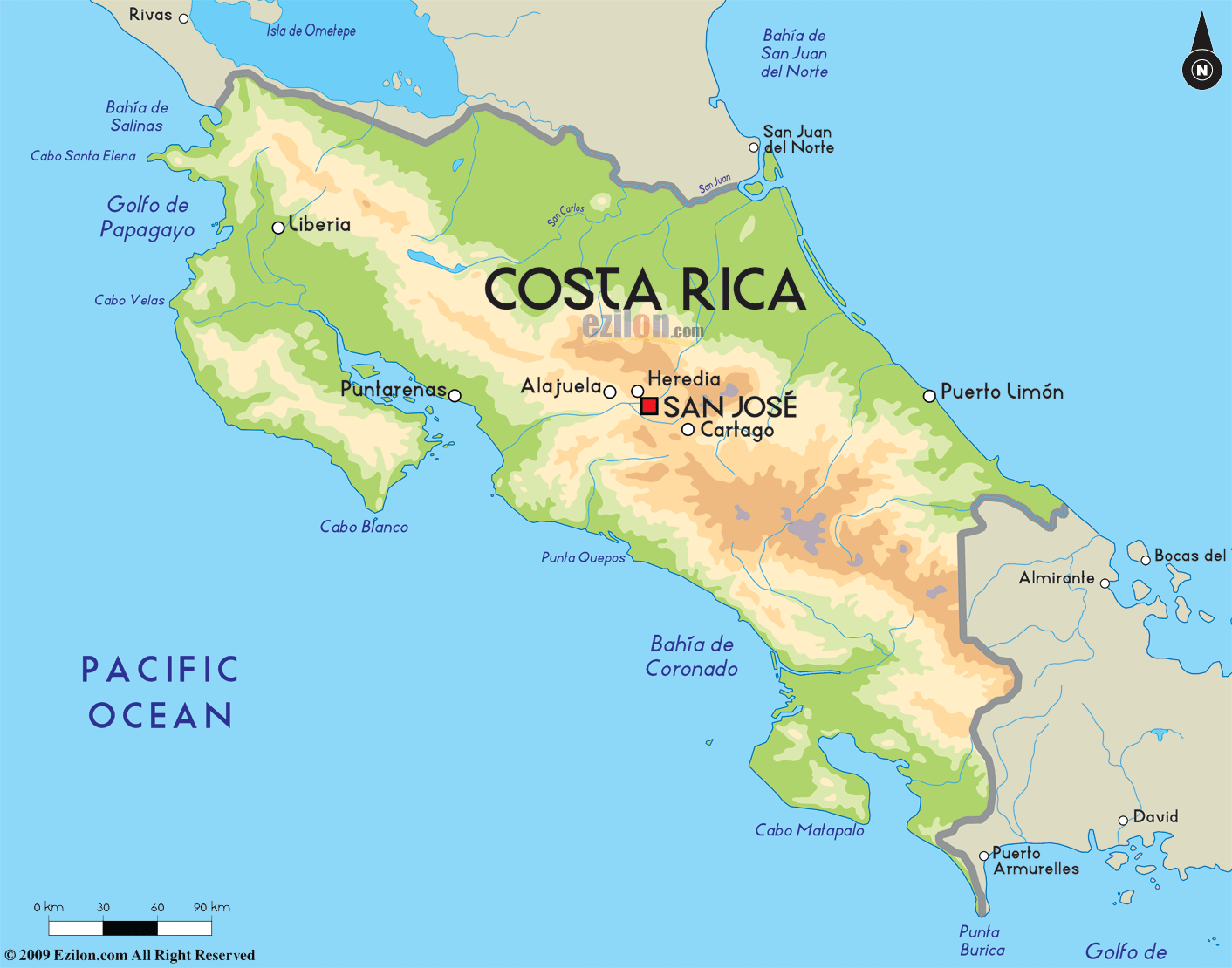
Teaching in Costa Rica

Costa Rica has a lot going for it. Spanish is spoken there, so many people who studied high school Spanish will be able to brush up on their skills. You can either study Spanish at a language school or you might be able to arrange teaching English in exchange for Spanish lessons. There are other ways to live in Costa Rica. You might also want to take a look at teaching at international schools and teaching exchanges and fellowships to find out more.

Costa Rica is close enough to the US and Canada, so is a nice option for teachers who don't want to experience a drastically different culture, like Asia. The weather is fantastic and the sheer beauty of the country will have you eagerly waiting for vacations so that you can go out and explore everything that Costa Rica has to offer from the beautiful beaches to the steamy rain forest.

Most people who go to Costa Rica do so for the lifestyle, not for the money. Be aware that while you may live very well, hit the beach in your free time, fantastic meals for less than $5 and being able to afford a maid, you may not bring a lot of money back home when you leave.

As far as safety goes, just as you wouldn't flaunt expensive goods in London or New York, you shouldn't do it in Costa Rica either. Try to dress like a local and keep your expensive items under wraps and locked up and you should be fine. Below you can find a lot of information about teaching in Costa Rica, as well as recommended institutes to work for. For FAQs about Costa Rica, please visit the Costa Rica section in the FAQs for teaching in Latin America.

Where to Live and What to Bring
Many people head to San Jose because it's the capital, however, many people have fallen in love with Heredia. It has a great nightlife and is not as hectic as San Jose. It's also home to Intercultura, an institute that constantly gets good reviews on Dave's. The Central Valley is a popular choice to live in as is Escazu, Santa Ana, Cariari, Sabana, and Rohrmoser.

Bring twice the money and half your stuff and you should be fine. Be careful about bringing too much with you. Toiletries and electronics are more expensive, so bring those things with you. However, you can buy just about anything you need in Costa Rica or have it shipped to you later if you decide to stay. Remember, you're probably not going to move to Costa Rica permanently, so don't bring your entire life with you. The weather gets pretty cool at night, so bring a sweater. You'll also need an umbrella and rain coat, but you can easily buy them there.

Learning Spanish
The place where you work might be able to offer you Spanish lessons. If they don't then you still have a lot of options open to you. You could try getting a language exchange partner, finding a private teacher, or enrolling in an institute. You can find exchange partners and private teachers on Craigslist. And you can find institutes at Go Abroad.

Mature Teachers
Many people want to continue working after they retire and Costa Rica is perfect for that. Ingles Empresial and Whittemore de Costa Rica have been known to hire older teachers. As an older teacher you have a lot to offer, so stress that during the interview. Taking a TEFL certification course also might help you out.


Bringing the Family
Again, if you are at teaching at international school or married to a Costa Rican, things are much easier. For those wanting to go to Costa Rica with their partner, spouse, boyfriend or girlfriend, if you can both get jobs, then you should be ok.

If you have kids, that's a whole different matter. Schooling is going to be an issue, it'll be nearly impossible to pay for an international school on the salary you can make as an ESL teacher. If they're Spanish speakers, they might be able to go to a local school. Or if they're young enough, you could simply send them to school and have them pick up the language. Another thing to consider is daycare. And don't forget more people means that you'll be spending more money. Bottom line: if you're going to bring kids into the equation, you're going to have to do a lot of planning and budgeting.

Getting a Job
Costa Ricans place a high standard on meeting people face-to-face, so you'll find that while you may email your CV out to many employers, few will respond. Teachers who work in Costa Rica recommend simply coming and knocking on doors. Recruiters aren't used to find job and if you scout the job boards, you won't find many teaching positions for Costa Rica, except for maybe the Tico Times and Craigslist. If you're a qualified teacher, you might want to look into teaching at international schools.

The thing about teaching in Costa Rica is that some institutes may only offer you a few hours a week and those will be split shifts staggered throughout the city. That means that you'll spend a lot of time travelling, and you probably won't be paid for all the time and effort that goes into commuting across the city. It's worth asking where the jobs are and if there's extra pay for in-company classes.

When cold calling, wear professional clothing. Unfortunately, a lot of teachers that come to Costa Rica are young and inexperienced, or simply looking for a way to make a bit of extra cash while living in paradise. There are reasons why many companies will not hire young people. So if you're young, you can counter these stereotypes by dressing and acting professionally. Have your CV printed out with your contact information for Costa Rica. You should be able to buy a pre-paid (pre pago) cell phone so that employers can contact you. Put your photo on your CV as well; it's a basic part of a CV in most of the world. Read more about creating a teaching CV. As far as interviews go, be polite and professional, just as you would if you were applying for a job back home. Take a look at this sample interview at Innovative English.

Visas
If you work for an international school, then you're in luck and you'll get a visa. Ditto goes for being married to a Costa Rican. Otherwise, the majority of you are looking at border hopping to Panama every 90 days and staying there for at least 72 hours. It's not that bad and pretty common. In addition, it's a great excuse to take a short vacation and visit another country!

Getting a TEFL Cert
Ideally, all teachers would get one, however, they're not cheap and you'll need to take a month off work to complete one. There are plenty of TEFL training institutes in Costa Rica. You can find many at TEFL certification abroad. In addition, look at is a TEFL cert necessary?


Recommended Institutes
Most institutes will want you to be able to commit at least six months teaching with them. So if you're thinking of staying for a shorter amount of time, you're going to have more difficulty finding a job. There are many other good institutes out there, but there are also bad ones. Try reading warning signs of bad institutes to learn the signs of a bad place to work.

Recommended Universities
Finding a university job in Costa Rica is going to take time, effort, and most importantly connections. You could be highly qualified and still not get the job simply because you don't know the right people. This is just another great reason why you should go to conference and meet people.

Recommended International Schools
If you want to teach at an international school, you're going to have to be a qualified teacher in your home country and have at least two years teaching experience. Read more about teaching at international schools

Cost of Living
Costa Rica isn't as cheap as you might think. Housing will be your biggest cost, but you could decrease that by sharing accommodations, living in student areas, or a simple flat. If you want a decent apartment, be prepared to shell out about $400 a month. Compare that to about $150 for shared accommodations.

Bring a bit of extra money to help you get started. You probably won't get paid for a month after you start working and it might take you a while to get a full schedule of classes, so a couple thousand dollars will help make the move easier. If you want to live like locals, that means using public transport, eating at home, and having a modest apartment, you should be ok. However, if you want to live the high life like an expat, realise that you're going to have to have a lot of extra cash to fall back on. If you learn to budget, you should be fine.

Private Classes
Many teachers choose to supplement their income by teaching private lessons. There are lots of opportunities to teach businesspeople English. It's a great source of income, but be aware that you will have to put time and effort into planning your lesson plans and may also have to travel. You can find more information in the private student guide and tips for teaching 1-to-1 lessons.

Disclaimer:

Saturday, 14 July 2012

Hot Topic: Working Split Shifts

Occasionally you might have to work split shifts; this may be more common in Latin countries such as Latin America, Spain, or Italy.

Some people hate them and others love them. People who hate them say that they break up their day, but people who love them say it's nice to have a couple hours off in the afternoon to eat, sleep, or run errands.

What do you think?
Have you had to work split shifts? What did you think of them?

Got an idea for a hot topic?
Email me with your hot topic, name, and website (if you have one) and I'll post it ASAP.

Disclaimer:

Thursday, 26 April 2012

Job Site: Saxoncourt

Saxoncourt has jobs as well as TEFL cert courses.  As far as their jobs go, they have openings in China, Italy, Japan, Peru, Saudi Arabia, Spain, Taiwan, and Vietnam. They've been in the field since 1989, but you need to understand that they're recruiters. For example, in Asia, they often recruit for Shane English Schools, which doesn't have the best reputation.

Remember that some people hate recruiters and others love them. What I can say is that some of the info on their site seems way too good to be true. For example, pay is Peru is about £1300, which roughly works out to $2000. This is more than I got working for an international school in Peru. With most language institutes in Peru you're going to be making about $600 a month. They also claim that it takes about 6 months to get a working visa, when it usually only takes a month or two.

If you do a search for Saxoncourt on Dave's ESL Cafe you'll see that most people portray Saxoncourt in a negative light. I don't have first hand experience with them, but just reading their information about Peru makes me think that it's too good to be true. In addition, they recruit for countries where it's easy to find a job on your own. With the exception of Italy and Spain (if you don't have an EU passport, but even then the Ministry of Education has programmes for non-EUers) and Peru (you can find free lists of schools at The LA Job List), you can pretty much send out your CV after answering a job advert and get jobs in these countries. If I were you, I'd give them a pass and try to find a job on my own.

Got an idea for a job site?
Email me with your job site, name, and website (if you have one) and I'll post it ASAP.

Disclaimer:

Thursday, 19 April 2012

Job Site: KOE Knowledge of English

KOE Knowledge of English is a franchise based in Latin America. They currently have institutes in Colombia, Chile, the Dominican Republic, Ecuador, Mexico, Panama, and Venezuela.

Their site is in Spanish, so you might have to use google translate if you don't speak Spanish. While they don't advertise jobs per se, they do have a section called "paises and sedes" which means countries and institutes as well as a "contactenos" contact us section. So if you're looking to work in Latin America, you might want to take a look at KOE. You should also read the FAQ for Latin America if you'd like to teach there.


Got an idea for a job site?
Email me with your job site, name, and website (if you have one) and I'll post it ASAP.

Disclaimer:

Thursday, 22 March 2012

ESL Educators Blog Carnival: March 2012, Open Topic

From site.catholicfavors.com
The topic of March's ESL Educators Blog Carnival was an open topic. People wrote about a variety of topics such as teaching in Latin America and how to study language in the US. You can read people's opinions on Wandering Educators.

Disclaimer:

Privacy Policy and FTC Disclosure

Please read TEFL Tips' Privacy Policy and FTC Disclosure.
Paperblog
Google Analytics Alternative Google Analytics Alternative